














































































Capacities: di AI-assisted tool wey dey help you organize and take notes, e dey make your work life and intellectual life easier
Visit Website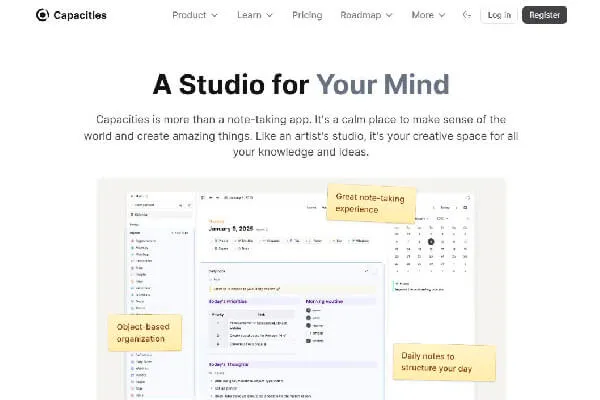
Capacities: AI tool wey dey manage knowledge wey go change how you dey think
Capacities na versatile tool wey get AI inside am. E be platform to manage personal knowledge. Plus, e dey help users take notes, and e no be like ordinary notepad.
Capacities dey allow you arrange ideas as interconnected objects (projects, people, concepts, etc.) wey dey help you understand the whole picture of your thoughts. Capacities environment dem design am to spark creativity and better organize your thinking.
Because dem wan break free from the limits of the traditional folder-style management, Michael Von Hohnhorst and Steffen Bleher wey be co-founders build Capacities.
Key people for the team na: Luis (Backend development), Jonas and Luca (Front-end development), Beth (content and community lead) and Réka (Marketing and growth).
Dem officially launch am for January 2022, and mobile expansion start from July 2024
Unlike competitors like Notion, Obsidian or Roam Research, Capacities no just focus on linking ideas together, e still put emphasis on experience wey dem tailor for individual user. You go see clean elegant interface, contextual integrations, and most importantly, AI assistant wey dem build to gist with your content. And no be only text generation e concern.
Strong AI features for knowledge management
Capacities get :
- Advanced information organization: notes na objects wey you fit link together, add customizable properties, and group into collections.
- Smart search: Capacities dey improve how you search inside contents and conversations.
- Built-in AI assistant: you fit ask am questions, run summaries, or request rephrasing directly inside notes, to make user ideas clearer or richer.
- Save AI chats as objects: the tool still let you save your AI conversations so you fit find and structure them later.
- Cross-platform and mobile: you fit access your data from mobile (iOS/Android) and enjoy smooth sync across devices.
The AI integration no be just side tool because e dey deeply connected to your knowledge base. AI chats dey turn to objects wey user fit link, tag, and archive. So quick one-off interactions dey transform to persistent, reusable thinking blocks.
Some advanced features like automatic full import from other tools (Notion, Obsidian) never fully mature yet. Some user feedback talk say performance fit get issue for very big documents or for some platforms. Dem still note say mobile experience, even though e dey, still dey evolve based on some feedback.
Capacities get several useful integrations:
- Extensions to quickly capture content: WhatsApp, Telegram, email, tweets, etc. ;
- Raycast and Web Highlights: to save or search ideas without opening the main app ;
- API for open beta so community fit build new connections.
Plenty use-cases for different kinds of users
Capacities mainly dey target writers, researchers, founders, managers, developers and students. E still dey target content creators.
- Content creators, writers and thinkers wey wan structure their ideas and make them grow.
- Students and researchers wey need organize plenty information and connect concepts.
- Knowledge professionals (consultants, trainers, strategists) wey wan visualize their data in a way wey no too linear like ordinary document.
For typical use-cases, we fit note :
- Thematic organization of advanced research ;
- Building personal thinking method, for example for thesis, book or long-term project ;
- Daily journaling wey AI dey enrich.
Capacities fit disappoint some profiles like :
- Users wey dey only chase pure productivity (simple task management, To-do lists) fit see am as too dense or too conceptual ;
- People wey want heavy automations or conversational AI wey no tie to notes fit find more specialized solutions elsewhere.
Capacities: smart but easy to start with
Capacities no be just app wey user go open, write note and forget. The “object” approach instead of pages or files need small mindset shift for newcomers. Na thinking logic, no be only storage.
For totally new user, e get small adjustment time, especially if you dey come from linear tools like folder-based systems. At first, e fit feel a bit “strange” to this network-style organization. But once person understand the logic of objects, relationships and contextual links, e go become productive fairly quickly. User feedback show say after few hours of trying things out, most people dey find natural flow inside the tool.
From the first open, Capacities dey give the vibe of modern, clean thinking space. The interface dey visually sweet. E dey simple without being boring, and e dey invite focus instead of distraction.
The overall usability dey smooth and well-polished. Menus dey clear, and how dem integrate features (search, object creation, backlinks) dey make sense. Even though the main feeling still be coherent and modern user experience, some advanced parts need small exploration time, like queries or “timeline” views.
Sometimes, based on community feedback, people dey notice small slowness or friction for very large data volumes, but nothing wey go stop daily use for most users.
Capacities provide structured official documentation with guides to start. Dem still get intro to key concepts and tutorials wey explain step-by-step how to think in object mode, plus the dense FAQ.
Apart from documentation, e get active community (especially for Discord and Reddit). For there, users and sometimes even the developers dey share tips, methods and best practices. E be real plus when you dey start. E dey make you feel like dem dey guide you instead of leaving you alone, because between structured docs, built-in assistant, and community gist, you no dey really get stuck.
First, the app dey accessible language-wise. E mainly dey in English and you fit translate am. Capacities na cross-platform. So e dey available for browser, with native apps for Windows, macOS, Linux, iOS and Android, plus smooth sync across all these devices.
Mobile support dey real and solid because user fit capture idea within seconds for phone, then see am again for computer. But the mobile interface still no strong pass desktop version for the most complex functions.
Affordable pricing for satisfied customers
Capacities dey use freemium model, with free basic version wey still generous and dey offer essential features.
The official project philosophy na to keep free version accessible long-term, while offering paid plans to fund continuous development and educational content around the tool.
Capacities get these costs :
- Basic (free) : unlimited spaces, objects and blocks, sync, offline support and full search, with about 5 GB limit for media.
- Pro : $9.99/month, wey give access to AI assistant, calendar integrations, smart queries, Web Highlights, extensions like Raycast, API, unlimited storage and more.
- Believer : from $12.49/month, wey add early access to new features and the satisfaction of directly supporting the independent team.
Dem usually dey offer free trial for Pro features, so you fit test the AI assistant and advanced tools before you commit.
The first thing wey go hit you about Capacities na the conceptual ambition, because na platform wey dem design to create structured second brain, where ideas, people, projects, quotes and reflections dey become living objects wey connect to each other.
Putting AI right inside the core of objects let you think with your content, not just around am. That one na subtle but powerful difference for people wey dey work on complex projects or long research.
The main downside wey users dey often mention na the learning curve. The object-based logic need small effort before you fit master am well, especially for people wey dey come from more linear tools.
Dem still talk say some advanced features never fully mature yet (like some integrations, API or some mobile options), and the lack of real-time collaboration fit be obstacle for team work.
Capacities na real discovery for deep thinkers like: researchers, writers, students wey dey do long-term projects, content creators, serious learners, and anybody wey wan structure their thinking in dynamic and evolving way.
More than just AI software, Capacities dey present itself as structured thinking environment, wey dem design to follow how ideas dey mature. E no replace human intelligence, but e dey amplify am by giving coherent, evolving framework wey respect long-term work.